Mitsubishi Returns to America’s Truck Market With Nissan’s Help
Mitsubishi has been one of the only large manufacturers to stay out of the lucrative pickup truck market in America for many years. Mitsubishi has concentrated on SUVs, crossovers, and foreign markets while rivals have been developing their truck ranges and profiting from the rising demand for tough utility vehicles. That could soon be altered.
With substantial assistance from its alliance partner, Nissan, the Japanese manufacturer has announced ambitions to re-enter the midsize truck market in the US.
Both vehicles could be pivotal in changing the future for the brand, as they try to regain some customers whose memories of the company are more capable off-road machines. A Return Years in the Making
Mitsubishi departed the U.S. truck market over a decade ago. The last pickup sold in America by the company was the Raider that disappeared after the 2009 model year.
The truck landscape has changed profoundly ever since.
One of the hottest segments in the industry today are midsize pickups. Recent sales of vehicles like the Nissan Frontier, Toyota Tacoma, Chevrolet Colorado and Ford Ranger have demonstrated that buyers in need of a more manageable package are still willing to buy trucks with impressive abilities both on- and off-road.
While rivals split into fiefdoms duking it out for every fraction of the market, Mitsubishi sat on the sidelines.
The company now believes the time is right to come back.
Instead of pouring billions into designing a whole new truck platform from the ground up — as is often the case to launch an all-new model — Mitsubishi is going about it in a different way. The company will use its partnership with Nissan to develop a new pickup that should be based on Nissan’s next-generation truck architecture.
It Will Be Based on a New Truck Platform From Nissan
There aren’t a lot of technical details available from Mitsubishi, but the industry already has a pretty good idea what we can expect.Nissan is also developing a new body-on-frame platform, and is slated to arrive roughly in 2028. It will serve as the basis for next-generation Frontier pickup, one of Nissan’s most critical big North American products. You are not restricted to the Frontier on the platform.Nissan is said to be planning to make use of it for a number of models, including an all-new Xterra SUV and a future body-on-frame Infiniti SUV.
Mitsubishi’s next product will likely be that family of trucks.The new pickup will most likely be closely related under the skin to the forthcoming Frontier, sharing much of its engineering, chassis design and powertrain technology. All that said, Mitsubishi will certainly give the truck unique styling, an interior design and suspension tuning.
Now this is a common practice for the whole industry. They use a common platform or components and differentiate products via design/brand character.For Mitsubishi it is a low-cost route back into an increasingly hot segment.
Built in America
Where the truck will be built is arguably one of the biggest news items from the project.
Mitsubishi said production will occur in the United States at Nissan’s plant in Canton, Mississippi.
That decision carries major advantages.The lack of anticipated import tariffs and shipping is a big reason why Mitsubishi is building the truck domestically. Allowing them to market the vehicle as American-built, which appeals well to many truck buyers.
Mitsubishi has no U.S. manufacturing presence and so would particularly benefit from the arrangement. Rather than spend big to build a new factory, the firm can use Nissan’s existing production infrastructure.
It only makes good business sense.
The deal allows Mitsubishi to enter one of the most lucrative segments in the industry, without having to spend billions on developing an all-new truck.
What About the Triton?
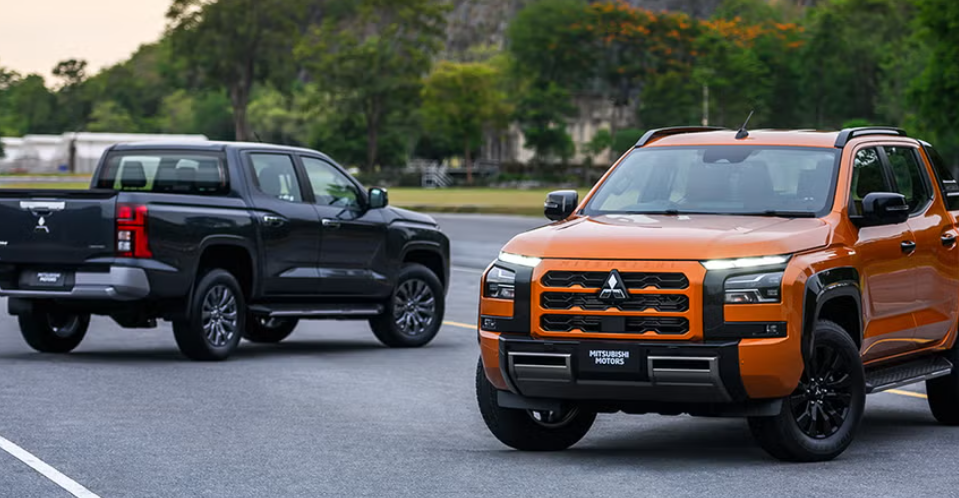
A question that comes to mind is why Mitsubishi doesn’t simply bring its existing Triton pickup to these shores.
The Triton is already on sale in many international markets and has earned a reputation as a rugged workhorse. It competes with cars like the Toyota Hilux and the Ford Ranger in a lot of markets though.Its probable, then, that the difference lies in regulations, customer expectations and manufacturing strategy.Making the current Triton comply with U.S. safety and emissions standards will take a lot of work, though. You would also require a local production fix to stay competitive.Mitsubishi could develop a truck for North American buyers based on an upcoming Nissan platform that Mitsubishi can build in the United States.That makes the truck based on the Nissan a more sensible long-term solution.
Step in a Larger Growth Plan
The new pickup was not simply going to fill a hole in Mitsubishi’s range.And much bigger plan related to increasing the sale of any company globally.Mitsubishi CEO Takao Kato also recently laid out plans to increase annual sales from about 797,000 vehicles in the fiscal year ending March 31 to around 930,000 vehicles by the early 2030s.That objective can be reached with new products, a firmer market place and better competitiveness in key regions.
The U.S. truck market is also a big opportunity.Even moderate success in the midsize truck category could provide significant volume of sales and a big boost to Mitsubishi’s bottom line in North America.The company also knows that all the while, trucks are entrenched in American automotive culture. Diving into the segment provides Mitsubishi with buyers it might never have reached in the past.
The Return of the Pajero
You aren’t only surprised by the pickup announcement.Mitsubishi has also confirmed it will revive the legendary Pajero nameplate.The Pajero was one of the most revered vehicles from the automaker, for decades. Some of the recognition abroad came from off-road adventures, rally racing successes as well as a reputation for solid reliability.In the States, American consumers knew it as the Montero.Because of the original Montero’s sweet spot between rugged capability and everyday usability, it developed a loyal following.Dodge also ultimately pulled it out of U.S. showrooms, but fans won’t forget its existence anytime soon.If the original Pajero was anything to go by, the new Pajero will be ready for a similar fight.Interestingly, the newest version is anticipated to receive its foundation from the overseas Triton pickup. Which implies an old-school, body-on-frame design more suited for heavy-duty off-roading rather than crossover-style cush.The new Pajero—or Montero—may or may not return to the U.S.
Building an Off-Road Family
The product is due to coincide with Mitsubishi’s plans for not one SUV.The automaker has also teased plans for a full Pajero family as shown by the first teaser images, which show several SUV models covered up.Details are still scarce, but the strategy is more or less what many automakers are doing today.Where automakers used to pin their off-roading hopes on a single flagship, now they are launching entire sub-brands built around the concept of adventure exploration and outdoor lifestyle.
Ford has Bronco.To this end, Jeep has a whole family of trail-ready models.Toyota is adding to its TRD and Land Cruiser lineups.
It looks like Mitsubishi is keen to join the trend.The Pajero name might even serve as the basis for a new family of muscular off-road models to help solidify the identity of the brand and draw in new buyers.
Electrification Is Also Coming
Although Mitsubishi is also investing in conventional trucks and SUVs, it has not neglected electrification.The automaker has already revealed plans for a compact EV, intended for the U.S. market.We expect that model to be closely related to the next-generation Leaf from Nissan, evidence of the increasing collaboration between the two companies.Mitsubishi’s strategy shows a desire to keep a diverse lineup.On one end are off-road and truck focused vehicles.At other end you have electric vehicles for better and more eco-conscious customers.Both expand a more diversified line intended to reach broader customers
A New Chapter for Mitsubishi
The upcoming pickup is much more than another fareware for Mitsubishi.It represents a return to an area where the company once competed, and also allows it to establish itself again on North American shores.Success is far from guaranteed. Against such strong competition in the midsize truck segment, a product this compelling will be needed to convince buyers.
Mitsubishi seems to have taken the sensible route however. Because it’s using Nissan’s knowhow and production facilities, as well as the company’s forthcoming truck platform, Ford is able to launch with considerably less risk than that of an entirely self-developed pickup.
But combined with the revived Pajero and a new electrical lineup, suddenly Mitsubishi’s future is looking far more ambitious than it has in years.Provided the plan follows suite, a Mitsubishi pickup could soon be in American garages, cohabiting with Frontiers, Tacomas, Rangers and Colorados. That would be quite the redemption for a brand that’s spent more than a decade away from truck duty.