
Engines Other Than The New Grand Sport’s 6.7-Liter V8
For decades now the Chevrolet Corvette has served as the showcase for General Motors’ latest V8 technology. From its debut in the early fifties, it has gone through generations of engineering advancements and performance milestones. Over the years, the car became synonymous with Chevrolet’s iconic small-block V8 — a family of engines that have powered the vast majority of Corvettes ever built.The latest Corvette Grand Sport, therefore, comes with an all-new 6.7-liter V8 that invokes a legendary displacement in Chevrolet’s past and is among the largest engines ever fitted to a production Corvette.
A Historic Displacement Returns
At the heart of the redesigned Corvette Grand Sport is a 6.7-liter (409 cu in) naturally aspirated V8.That might sound familiar to longtime Chevrolet fans, however, the original 409 engine dates way back to an earlier time and wasn’t in the Corvette. It instead gained fame in other sixties-era Chevrolet performance models.
Clearing the way for that historic displacement is a new engine built by Chevy’s latest small-block architecture.It epitomizes the fusion of centuries-old ranching experience with state-of-the-art engineering and design, maintaining classic volume while incorporating modern efficiency and performance technologies. It creates an engine that honors Chevy’s roots all while satisfying the needs of today’s performance-seeking cars.
As we talked about earlier, you NEVER want to take a small-block and try to make it a Big Block.
Most fans assume small-block as opposed to a big-block V8 is just a question of displacement.In fact, this distinction is about the engine specification as much as it is about its physical size. Both engine families, as part of Chevrolet history, have been offered in several displacements overlapping one another.
Small-block engines are distinguishably compact, lighter in weight and more efficient. They were developed for a strong performance-to-mass ratio to suit sporty applications.Big-blocks, however, were designed for larger dimensions and thicker components with an even greater focus on strength and endurance. Their design suited applications where extreme torque and high displacement were required.
Due to these disparities, a small-block engine may periodically have displacement equal to a big-block. This also explains how the new 409-cubic-inch V8 for the Corvette can be a small-block cousin despite once sharing a displacement figure with bigger-power engines.
A Brief History of Small-Block Power in the Corvette
The basis of the Corvette for much of its existence has been small-block V8s. Chevrolet progressively evolved the recipe by seeking to extract power from other areas rather than merely chasing a displacement figure, with a focus on efficiency, responsiveness and reliability.
Arguably its most iconic example was the new 350-cubic-inch V8, although it would add cubic inches with little in the way of internal changes, and power Corvettes across multiple generations to become nearly synonymous with American performance.Subsequent updates increased capacity to six litres, and then eventually 6.2-litres, for better performance much more through technology than radically increasing the engine size.
Such an approach allowed the Corvette to compete with sports cars from around the globe. The engineers also put time in to wringing out more power from relatively small, light-weight engines while maintaining the inherent balance, nimbleness, and handling characteristics which gave character to the Corvette experience.
The Legendary Seven-Liter LS7
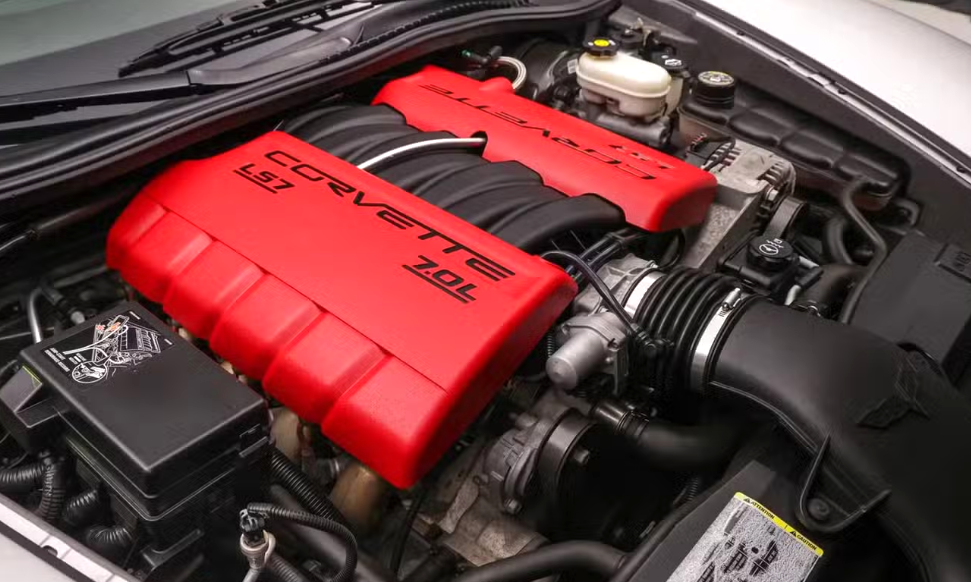
Previously, the largest small-block to ever set foot in a production Corvette was the storied LS7—until this new Grand Sport arrived. The LS7, which had a seven-liter (427-cubic-inch) displacement, first appeared in the Corvette Z06 around the mid-2000s.
It rapidly gained a reputation as one of the best naturally aspirated V8s GM had ever made.Aerodynamic ERD components kept it light, while sublime air intake and great natural tube work let the engine rev freely without bogging down—producing great performance and still relatively-close to world-class sports car response to input.
The LS7 is still one of the most beloved Corvette engines even years after the end of production. In this case, it was a unique character created by the marriage of large displacement and sophisticated engineering that still resonates among enthusiasts today.
The Infrequent Years Of Big-Block Corvettes
While the Vette is mostly imprisoned by those small-block engines, for a time, buyers were able to order factory-built Corvettes with Chevrolet’s larger big-block V8s. Through the late sixties and early seventies, big-block engine options in 427-cubic-inch and 454-cubic-inch displacements were offered as well forCorvettes.
These powerplants provided loads of torque together with blistering straight-line performance.But they also significantly increased the weight of the vehicle, which has been detrimental to handling. However, with emissions regulations tightening and engineering schools focusing on lighter, more efficient designs, it may have produced the last of the big-block Corvettes.
Switching back to the small-blocks let Chevy keep from only a performance standpoint, but also balance, efficiency and drivability. As engine technology progressed, big-blocks of large displacement also became less and less essential to stay competitive.
How The New Grand Sport Fits Into Corvette History
The introduction of the 6.7-liter Grand Sport brings the model to just about the tippy-top of Corvette displacement history. Only two production engines from Corvette are larger in displacement. That included the seven-liter LS7 small-block that powered the Corvette Z06. The other being the enormous 454 in3 (7.4-liter) big-block that was available during the golden years of muscle car sales.It is enough to make the new Grand Sport one of the biggest engines for Corvettes in modern history. Its 409-cubic-inch displacement straddles modern engineering with classic American performance tradition, occupying a unique spot in the Corvette catalog.
These days, naturally aspirated large-displacement engines are becoming rarer as the automotive market transitions towards electrification.
Result: The new V8 for the Grand Sport is more than just another powertrain upgrade. Basically, it celebrates Chevrolet’s storied history of making fantastic V8s while acknowledging that in the hearts and minds of performance enthusiasts, displacement still matters. This isn’t the first time we’ve seen teasing of an even larger model in GM’s sports car history, but it’ll join only two Corvettes ever carrying bigger engines and earns its place along with the most memorable models the nameplate has built.












Comments
2
[…] inside the Armada Nismo, the performance theme continues. For sportier feel, cabin is covered in two-tone black leather with red suede inserts. They are formal-appearance […]
[…] pairing of engine and transmission emphasizes the automaker’s focus on an enjoyable driving experience. In […]