1971 Ford F-100 on Bring a Trailer Is More Than a Truck — It’s a Rolling Piece of Racing History
Old cars are treated like royalty when they get old. They get polished. Cleaned all the time and are kept in special garages with controlled temperature. They look amazing when they are shown off at car meets better than when they were brand new. That is what people usually want for their cars.
And you notice something quite different.
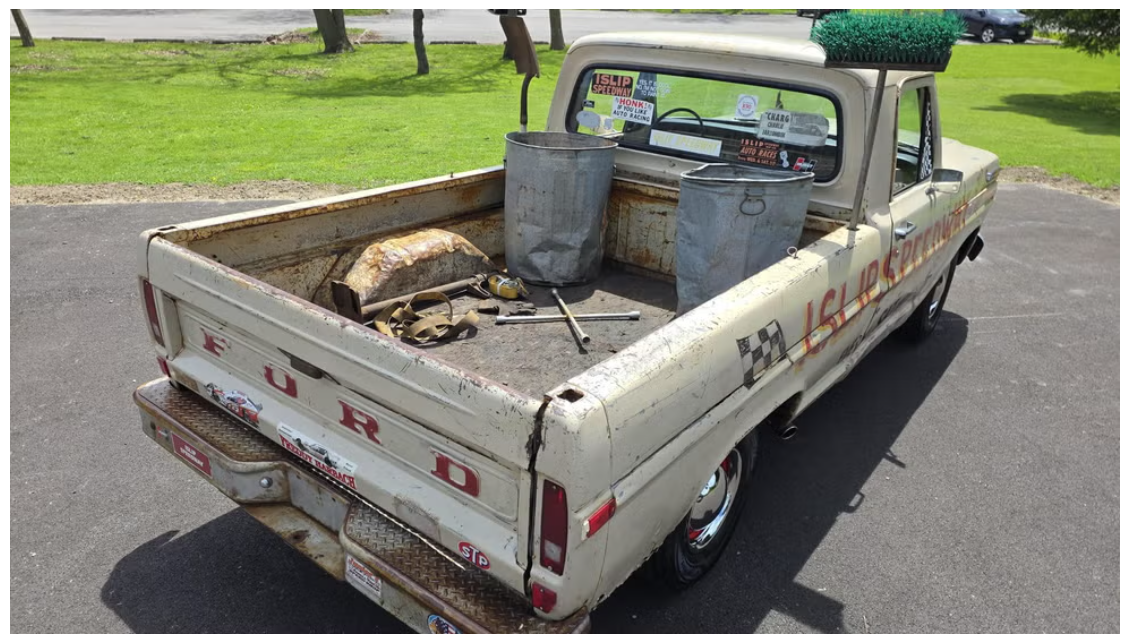
There was also a 1971 Ford F-100 Sport Custom in Bring a Trailer.This truck is special since it has flaws. It has dents. The paint is faded. The old graphics on the side are worn out. You can see that this truck has been worked hard for years. That is what makes it valuable.
This, in my opinion, is what really sets the truck apart.
It initially appears to be a very used truck. The paint is old and tired. The body has a lot of dents and scratches. The old racing graphics are faded from being in the sun for long.. When you find out where this truck came from it becomes really interesting.
This was not any old truck.
It used to work at Islip Speedway, which’s a famous old racetrack, on Long Island. This track used to be really loud with the sounds of cars racing and people cheering. There were also a lot of crashes.
Lots of crashes.
This old Ford F-100 Sport Custom truck was used to clean up after racing events and crashes. While the fancy cars were racing and trying to win this old truck was doing the work that nobody else wanted to do.
That makes it really cool.
A Truck That Witnessed Racing History
To understand why this F-100 is important you need to know about Islip Speedway.
Islip Speedway was on Long Island, New York.
The F-100 and racing were big deals back then and Islip Speedway was one of the places, in America where people went to watch races and the F-100 was a big part of that.
This Islip Speedway place did not look like a racetrack, with huge grandstands and lots of sponsors it was really different.
Islip Speedway was a grassroots racing track.
It was one of the racing tracks in America.
The F-100 is connected to Islip Speedway. Thats why it matters.
The racing track had a place, in the hearts of many racing fans.
On Saturday evenings passionate drivers would. Locals would visit Islip Speedway to watch the races.
The track became famous for something. People tell stories about Islip Speedway.
The person in charge Larry Mendelsohn noticed something during races in the 1950s.
When cars crashed the crowd would get really excited and cheer louder, than when someone won a race.
So Larry Mendelsohn had an idea. What if crashing was not an accident. The point of the event?
This idea helped start the demolition derby. Thats how a new kind of car racing was born. The demolition derby.
The derbies were very popular in the 1960s and 1970s.These explosive derbies were a thing. Folks loved the noise and excitement of derbies. They liked watching cars crash into each other in these derbies until only one car was still running. The excitement of derbies was really something.
Someone had to tidy up the mess when the fun was ended. This Ford F-100 filled that need.
The Unsung Hero of Race Day
Tickets to see folks clean up are not purchased.
Pictures of garbage trucks are not displayed in bedrooms.
Racing tracks need these people to work.
They cannot operate without them.
When there are accidents or oil leaks or the engine fails or the car is damaged workers bring out this F-100 truck.
This F-100 truck has brooms and cleaning tools and special things to soak up spills and all the other things they need to make the track good for racing
Cleaning up is not a job that people think about.
It is probably dirty most of the time.
This F-100 truck is always at the speedway.
Racing cars. Go and drivers leave and new drivers arrive but this old Ford F-100 truck is always there ready to do its job.
There is something about this F-100 truck.
It reminds you that racing is not about winning the race.
Racing is also, about the people and the F-100 truck that work behind the scenes to make the race happen.
A Front-Row Seat to NASCAR History
The racing history this truck directly observed is among its most fascinating biographical features.
In the year 1971, Islip Raceway hosted the {NGN} NASCAR Grand National. For the little Long Island racing community, this event was very significant because it marked the end of a certain period. I really do mean it when I say little.
The track was two-tenths of a mile around.
To give you an idea of how short that’s most NASCAR tracks nowadays are one to two miles long.
Drivers at Islip Speedway did not have time to get straight on the track before they had to turn again.
Racing at Islip Speedway was not easy.
You had to be patient and a driver. You had to be a little brave too.
This F-100 truck was at Islip Speedway.
It was parked somewhere inside the track or near the pits waiting for something to happen.
It saw cars racing close, to each other.
It saw cars break down. It saw some really exciting finishes.
Maybe it even helped clean up after some of the crashes.
We will never know everything that happened. That is what makes this story so great.
Patina That Can’t Be Recreated
Nowadays, individuals who collect trucks invest significant amounts of money to give their vehicles an aged appearance.
Some enthusiasts intentionally age the paint on their trucks. Others focus on making the stickers and images appear worn, creating the illusion that the truck has seen extensive use.
This truck is different.
It has a lot of dents and scratches. The pictures on the truck are. The parts are worn out.. All these things tell us that this truck has been working really hard for a long time. The letters, on this truck are painted by hand. That is what makes them special. They are not perfect. That is what makes them real.
This vehicle features checkered flags and racing motifs. These components show the history of the vehicle. It appears that no repairs or modifications have been made to this truck.
It can be laying in a garage and looks to have been ignored for some time. This automobile exudes authenticity without a doubt. The car gives you the impression that you have discovered something long lost.
The Stories Inside Are Even Better
The truck’s exterior is just one aspect of the narrative.
The Ford’s interior is still incredibly basic. It has a floor-mounted three-speed manual gearbox, a blanket-covered bench seat and all the personality you would expect from a pickup built in an era when vehicles were meant to be functional rather than showy.
However, the glovebox may contain the most intriguing detail.
People signed it throughout time.
drivers. Keep tabs on employees. companions. racing aficionados.
A recollection from a different place and time is represented by each signature. When they work together, they produce something that no repair business could ever match.
It is a living history of the racing culture in the area.
The nicest part is that it was all unplanned. After decades of use, it happened organically.
Built to Work
The well-known 302-cubic-inch V8 engine is housed behind the hood. Even though it was a brand-new engine at the time, its output of slightly more than 200 horsepower may seem insignificant in today’s world.But the reputation 302’s was never built on its raw power. It was one of Ford’s most reputable and popular V8 engines because of its dependability, robustness, and smooth operation.
Its reputation was built on dependability.
It was well known that these engines could withstand abuse and still function year after year. Reliability was significantly more important for a speedway maintenance vehicle than performance.
here vehicle is still in service today because it recently received new tires and routine maintenance.
It’s much amazing when you think about it.
After decades of hauling maintaining racetracks, machinery, and weathering daily wear and tear, this antique Ford continues to run wonderfully.
Why Trucks Like This Matter
Most historic vehicles are expensive because they are unusual, powerful, or well-designed.
The F-100 is rare.
Its value is derived from its story.
It was not conserved because someone expected it to be a collectible. It survived because people recognised its ties to a world that has mostly vanished.
Across the United States, several local racetracks have closed. Rising costs, construction projects, and changing entertainment tastes have made it impossible for little tracks to survive, which were once the center of grassroots racing communities.
These vehicles assist to keep those memories alive.
They remind us that racing has always been about more than simply the drivers and race cars. They also honour the workers, volunteers, and regular citizens who made each race possible.
A Survivor Worth Preserving
The next owner of this truck must eventually make a decision.
Restore it entirely or leave it as is?
Many aficionados believe the answer is apparent.
A new layer of paint might erase years of history. New visuals would replace the originals, which had been in use for decades. Even the dents and faults contribute to the storyline.They are no longer flaws.
They’re evidence.
Evidence that this truck lived a real life and earned every mark it carries.
That’s what makes this Ford so appealing.
It never chased trophies. It never appeared on magazine covers. It simply showed up for work, night after night, doing a job that needed to be done.
Now, more than fifty years later, it’s become one of the most authentic pieces of racing history still on four wheels.
A little rough around the edges.
A little worn.
But still running.
And still telling stories.